The Crack Pattern Tells You Before Anyone Digs
A crack in a foundation wall is a symptom, not the problem itself, and the shape of it usually tells you which problem you are looking at.
September 10, 2026 · 3 min read
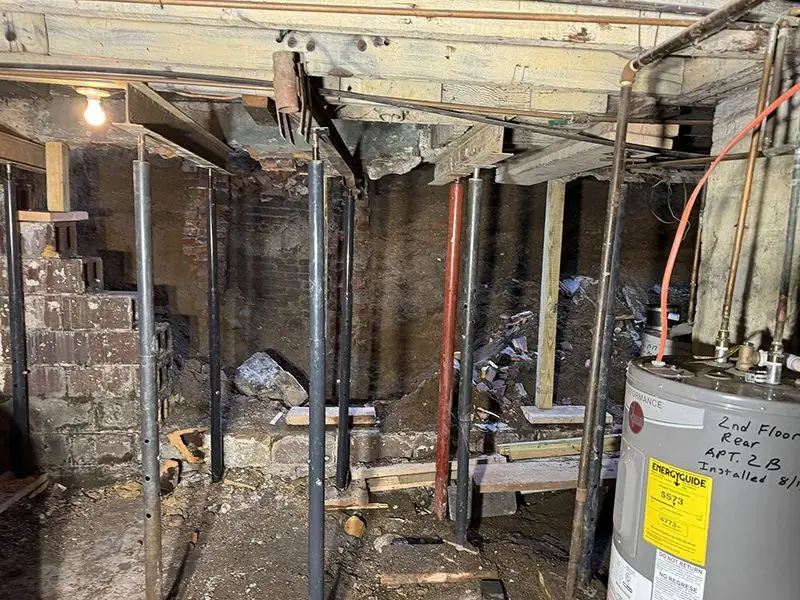
Every older house around Pittsburgh has at least one crack in the foundation somewhere, and most of them do not mean what people assume. A crack is just where the concrete or block gave a little under some kind of pressure. What matters is the direction it runs, how wide it is, and whether it is still moving. Read that correctly and you already know roughly what you are dealing with before anyone picks up a shovel.
Vertical cracks are usually the least of your worries
A straight vertical crack, running up and down, is most often just concrete doing what concrete does as it cures and shrinks over its first year or two. It tends to be thin, fairly consistent in width top to bottom, and does not get worse over time. That is not the same as no crack at all. Water can still find its way through a vertical crack during a heavy rain, but it is rarely a structural signal on its own.
Horizontal cracks are the ones to take seriously
A crack running sideways across a foundation wall, especially one low in the wall or paired with the wall bowing inward even slightly, is a different situation. That pattern points to lateral pressure pushing on the wall from outside, usually wet or expansive soil against the foundation with nowhere for the water to go. Allegheny County's clay soil holds water and then swells when it is saturated, and clay sitting right up against an old foundation wall with poor drainage will push on that wall for years before anyone notices the crack. A horizontal crack that is widening, or a wall you can see is no longer flat, needs attention soon rather than watching and waiting.
Stair step cracks follow the mortar joints
In a block or brick foundation, cracks often do not run straight. They zig zag along the mortar joints in a stair step pattern, because mortar is the weakest material in the wall and gives before the block does. Stair step cracking usually points to uneven settling: one part of the foundation is sitting on soil that has compacted or shifted differently than the rest of it, so that corner or section is dropping relative to the rest of the house. It is common near additions, porches, or anywhere the original footing depth changes.
What the freeze thaw cycle adds to all of it
Western Pennsylvania winters make every one of these patterns worse than the same crack would be somewhere with a milder, drier climate. Water that gets into a crack of any kind freezes and expands, widening the crack a little more each winter regardless of what caused it originally. That is why a hairline crack ignored for a few years often is not a hairline crack anymore, and why the sooner one gets sealed, and structurally addressed if it needs to be, the smaller the eventual job stays.
Age of the crack matters as much as its shape
A crack that has been there for years, hasn't widened, and doesn't line up with any recent change to the house is a different conversation than one that showed up after a wet spring or opened noticeably wider over one winter. Marking a crack with a pencil line and a date, and checking it again after a season, tells you more than staring at it once ever will. If the pencil line still lines up a few months later, that crack has probably settled into whatever it is going to be. If it doesn't, the soil or the structure underneath it is still moving, and that's the crack worth calling in before it gets bigger.
What we actually do about it
Depending on what the crack pattern and the soil around the house are telling us, foundation repair here ranges from sealing and monitoring, to underpinning with jack posts under a settling section, to replacing block where the wall itself has failed. We come look at the actual crack, inside and outside where we can get to it, before saying which one it needs. A free on site estimate, usually within about two weeks of the call, is how that conversation starts. (412) 386-0569 or mzokaitesmasonry@gmail.com.
M. Zokaites Masonry, (412) 386-0569
Call (412) 386-0569More articles
Reading a Failing Chimney: What a Cracked Crown Actually Lets In
The chimney rarely fails all at once. It fails one open joint at a time, and knowing what you are looking at is most of the battle.
Why Mortar Matching Actually Matters on an Older House
A repair that does not match the mortar around it is often worse for the house than the damage it was meant to fix.