04
Brick Pointing, Tuck Pointing & Lintel Repair
Mortar cut out and replaced properly, colour and joint profile matched to what is already there, and lintels assessed, reinforced and sealed before the face gets restored.
Chapter 01
Brick pointing and tuck pointing: cutting out what failed, not covering it
Brick pointing and tuck pointing get used almost interchangeably on the phone, and both come down to the same job: mortar that has failed gets cut out and replaced with mortar that will hold for decades, not mortar smeared over the top of a joint that is already cracked.
Older brick and stone in this part of western Pennsylvania has usually been through repointing before, sometimes done well and sometimes not, and the first thing to work out on any job is how much of the existing mortar is actually still doing its job before deciding how much comes out.
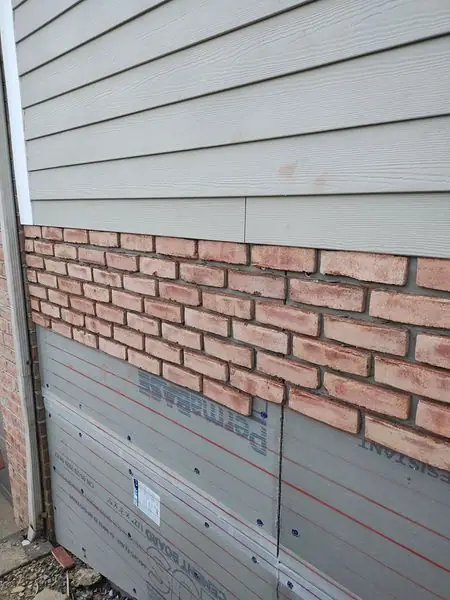
Close detail of brick veneer and mortar joints installed against existing siding
Grinding out failed mortar without damaging the brick
The mortar has to come out to a consistent depth before new mortar goes back in, and doing that with a grinder next to old brick is where a repointing job either goes right or chips the face of brick that has stood for a hundred years. The joint gets cut, not the brick.
Older brick, especially anything laid before modern fired brick became standard, is often softer than the mortar around it, which is the opposite of how a newer wall behaves. Grinding it the same way you would a modern block wall is how a repointing job ends up damaging the very brick it was meant to preserve.
Chapter 03
Colour and joint profile matching on an older structure
Colour and brick matching on repairs to older structures is one of the things we are asked for most, and it is not just about the mortar shade. The joint profile, whether it sits flush, is struck concave, or is raked back from the face, changes how the whole wall reads from the street, and matching the wrong profile stands out as much as the wrong colour would.
New mortar also weathers differently than fifty year old mortar for the first year or two while it cures and settles into colour, which is worth knowing going in rather than being surprised by later.
Lintels: assess, reinforce, replace, seal, then restore the face
A lintel is the structural piece carrying the brick or stone above a window or door opening, and when it fails the sign is usually a stair-step crack radiating up and out from the corner of the opening, not a crack in the lintel itself. The sequence is always the same: assess what is actually carrying the load now, reinforce or replace the lintel itself, seal it against water so the same failure does not start again, then restore the face so the repair is not the first thing anyone notices about the wall.
Skipping the sealing step is the most common shortcut we see on older repairs elsewhere, and it is why the same lintel problem tends to come back within a few years on a house that has had it patched before.
Zokaites Masonry, Fully licensed and insured. PA contractor licence PA121063. Call (412) 386-0569.
Re-pointing, on a chimney
What re-pointing looks like from the customer’s side
“I had a great experience with M.Zokaites Masonry. First thing’s first, they actually answered when calling for a quote for re-pointing our chimney, which wasn’t the case for others in the area. Mike came over to do a quote shortly thereafter and it was reasonably priced for the amount of work to be done.”