03
Block & Stone Retaining Walls
Reinforced concrete block systems including Versa-Lok, and natural or manufactured stone laid dry stacked or mortared, with the drainage behind the wall built in from the start.
Chapter 01
Block or stone: how the call gets made
A retaining wall has one job whichever material it is built from: hold back soil that wants to move, on a hillside lot or a graded slope where water has nowhere else to go. Which material is right depends on the height of the wall, what it is holding back, and what the finished job needs to look like next to the house.
Reinforced concrete block carries more load in less wall thickness, which matters on a taller cut or anywhere the soil behind it is heavy clay. Natural and manufactured stone read better against an older house or a finished landscape. Plenty of jobs use both, block doing the structural work lower down with stone facing above it.
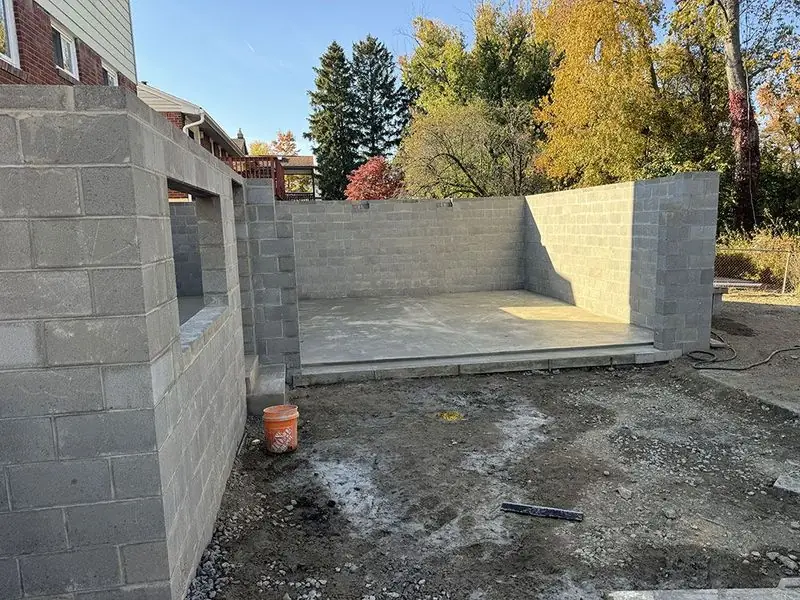
New concrete masonry unit block wall under construction on an autumn exterior in Allegheny County
Precision block laying and reinforced wall systems, Versa-Lok included
Concrete masonry unit walls go in course by course, with the block set level and plumb the whole run rather than adjusted at the end. On anything past a low garden wall, that means reinforcement, steel and grout in the cores carrying the load the wall itself cannot hold on mass alone.
Versa-Lok is one of the interlocking systems we install for taller retaining sections, block that locks course to course without mortar joints to fail later. It goes in fast and it holds up well on a slope with real grade change, which is most of what a North Hills hillside lot asks for.
Chapter 03
Dry stacked or mortared: where each stone wall belongs
A dry stacked stone wall relies on the weight and fit of the stone itself, no mortar holding the joints, which is the traditional way a low garden or terrace wall gets built and it moves with frost instead of cracking against it. It is not the right answer for a tall retaining wall carrying real soil pressure.
Mortared stone, natural or manufactured, is what goes in when the wall is doing structural work rather than just marking a bed line, since the joints tie the whole face together into one unit. Choosing between them is not a style preference, it is a question of how much weight the wall is actually carrying.
Drainage and moisture resistant finishes: the half of a wall nobody sees
The visible face of a retaining wall is maybe a third of the job. Behind it there should be gravel backfill and a drain line carrying water away from the wall instead of letting it pool against the back of the block or stone, because saturated clay soil pushing on a wall in a freeze is what cracks and shifts a wall that looked fine going in.
Moisture resistant finishes on the block face do the same job from the front, keeping water from wicking into the material through the freeze-thaw cycles a western Pennsylvania winter runs through repeatedly between November and March. A wall built without the drainage behind it is a wall that is going to move eventually, whatever the face looks like today.
Zokaites Masonry, Fully licensed and insured. PA contractor licence PA121063. Call (412) 386-0569.
Block on one job, stone on another
“Mike blocked a house for me and his guys were good, quick, and reasonably priced. I have also used him for stone on another project. Both projects were done very well and in a professional manner. I would recommend him for any new block, stone work or restoration.”